
Ultrasonic Cleaning
Ultrasonic cleaning is the state of the art in instrument cleaning. Instead of the caustic chemicals used in traditional chem cleans, your instrument is cleaned by high-frequency sound waves — removing calcium deposits and corrosion while preserving its quality.
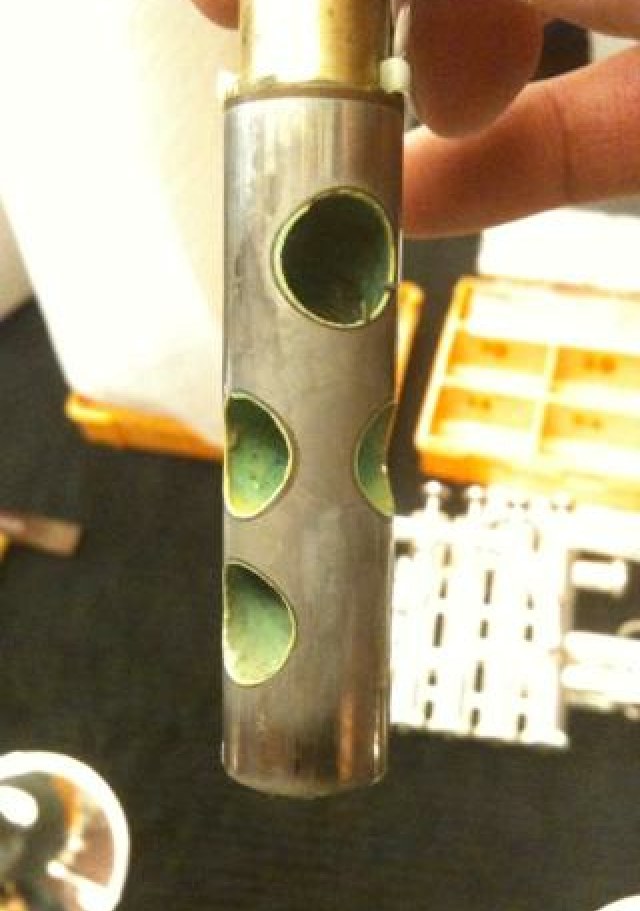 Before
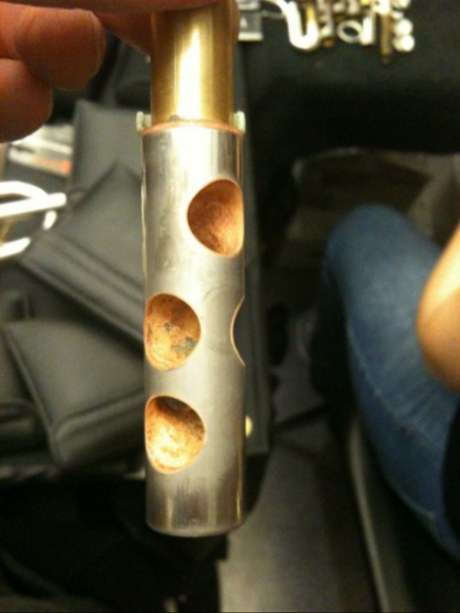 After
How It Works
The science behind a deeper clean, in three steps.
1
Cavitation
High-frequency, high-intensity sound waves introduced into the cleaning solution form countless microscopic bubbles, each holding a partial vacuum.
2
Implosion
As pressure builds, the fluid rushes in and collapses each bubble, creating a jet of liquid with temperatures as high as 5,000°C and pressures up to 20,000 psi in a tiny, concentrated area.
3
Deep scrubbing
Those countless imploding bubbles scrub every surface the solution reaches — including hidden passages a brush can’t — lifting away calcium, scale and corrosion.
See the Difference
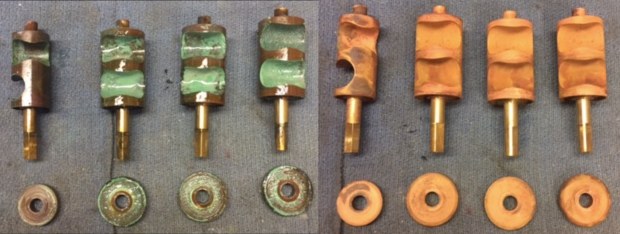
Valve pistons before (left) and after (right) an ultrasonic cleaning.
Once you’ve tried it
you’ll never go back to conventional cleanings again.
Wondering whether ultrasonic cleaning is safe for an older instrument? See our FAQs.